


Discrimination by the CKIs
UPDATED 3-OCT-2026
Please note this section contains information about transphobia/transmisogyny/racism/ableism/sanism/fatphobia. Be kind to yourself when reading this section, and take breaks if needed.
This section has been developed as a result of community knowledge. We are always seeking to increase knowledge of treatment that we experience within the CKIs. If you would like to share your experiences please email transparens.gay@protonmail.com or anonymously complete our questionnaire.
Why we have chosen to include this information
-
Gatekeeping[1] is a key part of how these clinics operate. See our CKI article for more.
-
Building up our knowledge as a community helps affirm our experiences within these clinics.
-
This information supports us in advocating for ourselves/communities when interacting with CKI and helps us understand that there are better alternatives.
-
The visibility of CKI's horrors is necessary for people to understand the trauma CKI inflicts on trans people. We understand that some might have had experiences they would describe as positive with specific CKIs or staff, however this does not absolve the CKIs of the violence, denials for treatment, and abuse of power. Receiving the bare minimum or not being traumatized does not mean that treatment was "good".
-
Trans people that do not reflect CKI's/staff members' idea of how we should behave, think and express ourselves can end up modifying themselves in an attempt to ensure that they are not denied treatment. We know that no one should be required to fit CKIs/staff members' ideas because ultimately we know who we are and no CKI/staff member knows us better than ourselves.
In our CKI article, we wrote about CKI as an institution and what actually happens step-by-step as you go through the arbitrary process that is completely unnecessary for CKI to force upon us. In this article, we want to highlight the discrimination that can happen throughout, even though the process in itself is already horrifying. Please note that even if all these different types of discrimination magically disappeared, CKI would still not be a "good" institution. They would still want to gatekeep our gender-affirming care, as they exist to deny us our care, not to provide us care.[2]
Lack of intersectionality
CKI and staff have a lack of awareness of the importance of intersectionality when meeting trans people. Intersectionality was a term coined by Kimberlé Crenshaw, to help explain how our identities overlap and intersect (and cannot be separated).[3] Our race, gender, sexuality, religion, class, body size, disabilities, languages, gender expression, culture, social context, and many other aspects, shape our entire being. For the clinics to try to separate our gender identities and expressions from these other, just as important, parts of ourselves is a deep disservice to our communities.
The whiteness of CKI's gender expectations
An important element in how CKI examines you is your gender expression and how you identify, but all three CKIs lack the ability to see how whiteness has impacted the way they perceive our community. White European beauty standards have become the milestone of determining what is considered 'appropriate' expression. For example, CKI considers certain forms of expression that challenge these status quo ideas of white beauty ideals as lacking ‘seriousness’ when seeking treatment. This could for example be so-called ‘masculine’ presenting transfemmes and trans women or if they have body/facial hair, or ‘feminine’ presenting trans men and trans mascs or if they wear make-up, paint their nails, wear dresses etc. But for the trans community this can be a reflection of staying connected or reconnecting to their own culture's relationship to gender (or lack of gender) expression/beauty, challenging a binary idea of what gender or gender expression is, or just enjoying elements of themselves that for them have nothing to do with their gender! For some, these exact types of expressions can highlight how an individual has thought about their gender expression.
Individuals whose gender expression does not align with CKI's idea of what men and women should look like (cisgender white Western beauty ideals) might experience this being written in their journal notes by staff. Individuals have reported staff saying that 'if a trans woman were to have a beard' they would write that within their notes, the insinuation being that this means that a trans woman 'is not taking the process seriously' or is 'not ready'.[4] CKI weaponises our community's diverse expressions to insinuate that it reflects a lack of knowing who we are. We as individuals know what beauty is to us (and whether that is a goal for us) and wanting to undergo HRT or any specific surgeries does not mean that you are required to reflect certain cisgender white Western beauty ideals.
Some individuals also might not be interested in their gender expression or how they are perceived by others. Your relationship to your gender can also not be related to gender expression, and that is valid.
The perception of masculinity and femininity is also very individual and informed by cultural norms. See this screenshot of a person who wore the exact same clothing to every CKI appointment, and was still described as "feminine" and "masculine" on separate occasions.
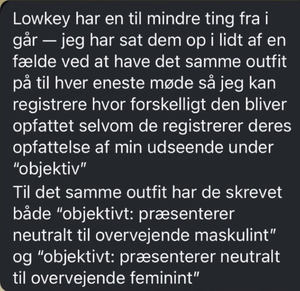
English Translation:
"Lowkey, I have a small thing from yesterday - I set a little bit of a trap for them by wearing the exact same outfit to every single meeting, so that I can track how differently it gets perceived, even though they categorize their observations of my presentation as "objective"
For the exact same outfit, they've written both "objective: presents as neutral to predominantly masculine" and "objective: presents as neutral to predominantly feminine""
The cost of "beauty"
To be able to present in a form that affirms white European beauty ideals (even if that is someone's goal) can be a great expense, financially or otherwise, and obviously disproportionately negatively affects BIPOC. Beauty ideals are also interconnected with capitalism, and being able to afford clothing or treatments is a burden of cost only obtainable to few. As well as a financial cost, there is an emotional cost or a safety cost that many do not have access to.
Gender expression and how you desire to express it is incredibly complex, and to place the burden of responsibility on a trans individual instead of recognising the structural elements that impact this, is not only individualistic but shows CKI's lack of ability to see and understand our community's intricate struggles.
Being genderfluid or non-binary
Non-binary people have reported that clinics are not viewing being non-binary as an example of lack of knowing who we are. However, non-binary people have experienced CKI and individual staff still projecting ideas of how non-binary people should express their gender and talk about their experiences. An example of this is that non-binary people who are seeking testosterone must still express this through 'masculine' clothing i.e. shirts and trousers.[5] We have inside knowledge that individuals who have led training workshops to CKI say staff members have denied the validity of non-binary as a gender identity.[5] According to a response on our questionnaire, "Sadly the system isn't fit to handle genderqueer and non-binary answers to trans healthcare just yet. I have not yet received HRT."
Having a "short, unclear, or unstable gender identity" is an exclusion criteria for being referred to CKI.[6] This is obviously ridiculous as this excludes certain genderfluid people and also highlights a lack of understanding of all the myriad of ways our genders can be (and expressed). It also means that some genderfluid folks are not able to go through CKI without lying to them (but we encourage lying to them anyways - see our CKI article for more).
Currently, if you wish to undergo top surgery through CKI, different CKIs have different requirements.[7] CKI Copenhagen requires that you undergo hormone replacement therapy (HRT) before top surgery (around 6-9 months). CKI Copenhagen staff have claimed this is due to 'getting the best results'[4], so that chest muscles can become more defined before top surgery. But CKI Aalborg offers top surgery without the HRT requirement.[7] This is an example of how arbitrary CKI's "requirements" are, and how they gatekeep services because of their own idea of what the 'best results' are. Some might not wish to undergo HRT, some might decide later, and some might not be interested in specific results. We should decide individually what results we would like; it should not be CKI who decides. We have a right to bodily autonomy.
Gender Incongruence
Prior to 2017, Denmark used the International Statistical Classification of Diseases and Related Health Problems (10th edition) to record in their public healthcare system 'transsexualism' as the official code for trans people who sought gender affirming treatment. This code of 'transsexualism' was listed under 'mental and behavioural disorders'[8] and reinforced the idea that our transness is a mental disorder. Currently, Denmark follows their own coding system[9] which presents in our journals as one of the following:
- DZ76 People in contact with healthcare for other reasons
- DZ768 Contact with healthcare services in other circumstances
- DZ768E Contact due to gender identity issues
- DZ768E1 Contact due to transgenderism
- DZ768E2 Contact due to gender identity issues in childhood
- DZ768E3 Contact due to other gender identity issues
- DZ768E4 Contact due to gender identity issues UNS
All three CKIs favour using no.7. It's important to note these are not diagnoses, however you will be able to view it in your health journal under 'diagnosis'. Denmark is currently working towards adopting the ICD-11.[10]
In order to gain treatment at one of the three CKIs, staff members will try to assess whether they believe you experience 'gender incongruence' or dysphoria. This is because the current Danish Healthcare Authorities framework for gender places emphasis on CKI assessing a person's 'gender discomfort' (with no inclusion of gender euphoria) to justify our treatment.
We know that trans people have reported staff members saying that their goal is not to 'legitimise' or 'delegitimise' a person's transness.[4] But, this framing of transness through the lens of having gender incongruence and ultimately needing this as a 'diagnosis' has been a way to pathologise[11] us and control us.
Not all people who wish to undergo HRT/surgeries or other treatments experience incongruence. We have reports of CKI expecting individuals to not like their body, to be uncomfortable in their body, and to not feel connected with their body to access care.[12] The framing of seeking treatment through pain, suffering, and discomfort helps reinforce that this is an essential element to being trans. Unfortunately because of this perception, it can lead some trans people to feeling/thinking that they are not trans because of the assumption that you must suffer. The focus on pain, suffering, and discomfort can also create a one-sided picture of a person's experience. Some might not experience these feelings/sensations at all, while others might experience these along with joy, laughter, connection, sexual intimacy, and euphoria.
No two trans people's experiences are alike. While some members of our community might connect to the feeling of incongruence, it is not a marker of a person's transness. Our relationship to ourselves is as complicated and full of nuance as any other cisgender person. To 'qualify' for our care through the level of suffering we experience is a disservice to our community, and has led to wrong perceptions of our communities.
Neurodivergence and ableism
If you are an autistic person with a diagnosis that is accessible within your medical journal, CKI can access this information. There are many individuals that have reported being denied treatment from CKI Copenhagen because of them being autistic, neurodivergent, or someone who expresses themselves in ways that doesn't conform to neuronormativity.[12] Our questionnaire has 4 responses that say people were denied specifically due to being autistic and/or having ADHD. We also know of at least two trans people who decided not to get diagnosed before going to CKI, in order to make the journey through CKI smoother. It is fucked up that people have to delay getting diagnosed in order to appease CKI to get life-saving health care.
CKI's ideas that autistic and people with ADHD are not capable of knowing who they are reflects an infantalisation[13] of neurodivergent people. Denying a neurodivergent person treatment because of their neurodivergence is a reflection of trans exclusionary radical feminist (TERF) rhetoric. TERFs have attempted to suggest that neurodivergence makes a person incapable of having the right to know and decide what their gender is and how they wish to express it. TERFs have weaponised statistics of autistic trans people to suggest that ultimately an autistic person's transness is a 'symptom' of them being neurodivergent. We have heard of doctors at CKI Copenhagen making suggestions that they think '1 in 6' trans people are neurodivergent.[12] Whether this is true or not, CKI's high level of rejection of autistic people due to their autism is ableism.
Sexual practices
CKI Copenhagen claims you are not required to talk about your sexual practices or sexuality, and choosing not to talk about it doesn't impact their decision.[4] However, as we do not have access to their multidisciplinary meetings (about us!!), we cannot verify this. We also know for sure that CKI does talk about your sexual practices and sexuality.[12] See also this screenshot here of an anonymous experience of CKI Odense shared by Adam Goslett on Instagram:
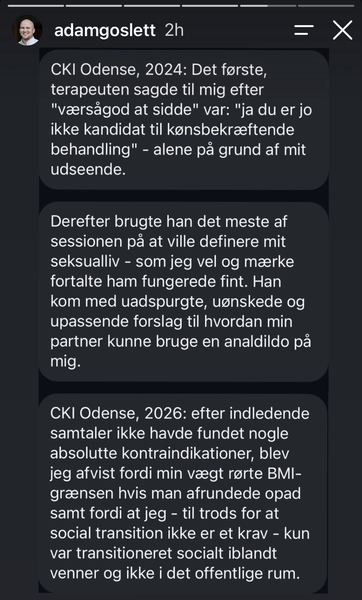
English Translation:
"CKI Odense, 2024: The first thing the therapist said to me after "please sit down" was: "yes, well, you're not a candidate for gender-affirming healthcare" - solely because of my appearance.
Thereafter, he spent most of the session trying to define my sex life - which, I should point out, I had told him was going fine. He made intrusive, unwanted, and inappropriate suggestions as to how my partner could use an anal dildo on me.
CKI Odense, 2026: after the initial consultations revealed no absolute contraindications, I was rejected because my weight touched the BMI-limit if you rounded up, and because I - despite social transition not being a requirement - had only transitioned socially among friends, and not in public."
This screenshot is only one example out of hundreds of the horrific treatment CKI subjects trans people to.
As talked about earlier, CKI still operates under the narrative that to want gender affirming surgeries, HRT or other treatment means you must have gender incongruence. This is not reflective of the trans community's experiences with themselves. Individuals can engage in sexual practices, feel connected to their body, feel affirmed in their body and engage with parts of their body that they still wish to change/modify/remove.
Sanism/treatment within other healthcare instances
Trans people who have an official diagnosis on their record of schizophrenia, schizoaffective disorder, bipolar, borderline personality disorder, or other diagnosis are often met with sanism[14] from CKI.[15]
The treatment can vary. Some trans individuals report that not being on medication and being 'stable' have reported not being rejected by CKI, however other trans individuals report rejection from CKI.[15] To reject a person because of CKI's perception that a person with a certain diagnosis cannot give informed consent or because CKI requires 'stability' from trans people is a direct example of sanism.
The concept of stability is pathologising, bound up in politics, and lacks intersectionality. To expect a trans person to be 'stable' leading up to and during their treatment lacks the understanding of the effects of transphobia on a person, or other structural oppression that impact their ability to obtain stability. This is not to suggest that all diagnoses are a result of transphobia, but to not recognise the correlation between the two lacks the political nuance that should be required of staff. With joblessness, lack of housing, violence, financial instability, and few support services existing for our community - how can any trans person be expected to be 'stable' within this climate?
The notion of stability is also rooted in colonial, capitalist, Western ideas. The ICD is historically political in what they consider a 'diagnosis' or a 'symptom' vs. what is labelled as 'normal'. The continuous gaslighting that trans people can experience as a result of living in a violently gender binary society can result in thoughts, feelings, actions that we deem as 'not normal'. But is that really 'not normal'? Or is that actually the most sane way to respond? And why are we even required to perform normativity or sanity? Who decides what is normal or sane?
This is not to suggest that those who experience sanism are not struggling (and that these struggles can also be due to other factors as well as transphobia) or romanticise their experiences. But merely to suggest that CKI is placing a too high expectation on trans people, and that CKI reflects the hyperindividualism[16] that we see within society. Ultimately, a trans person is able to know who they are, and any diagnosis a trans person might have should not infringe upon their ability to access care.
Individuals have also reported that CKI has required that they have completed treatment for their other diagnoses before being accepted by CKI.[17] This again fails to acknowledge a holistic understanding of (honestly people in general, but) particularly trans people, and also contributes to an understanding that the validity of our transness is dependent on other diagnoses, which it is not.[18]
In general, CKI has created narratives of how 'sad' a trans person should be in order to qualify for their treatment, but not too sad that you qualify for another diagnosis or aren't able to be 'stable'. Individuals have also reported CKI Copenhagen staff suggesting that some individuals have too high expectations of what is achievable with HRT, and that it 'can fix everything'.[12] This ambiguous tightrope line that we as a community are expected to walk is a further example of CKI's failures to not allow us to be complex human beings.
Young trans people
There are multiple reports of trans people's age being weaponised against them, to suggest that they can't know whether or not they are trans. Trans people have reported staff members at CKI Copenhagen saying that they are more likely to reject individuals under 25 years old.[4] This arbitrary number of 25 is also present in the CKI Aalborg guidelines that say clinicians should take note of whether or not people under the age of 25 have "the presence of a support network"[19]. As if people 25 and under are specifically in need of more support, and apparently once you turn 25, a support network is no longer needed! (This is obviously not true, please continue to foster your community and support networks throughout your life).
Trans people under 18 are treated even worse than those over 18 - in fact, essentially none of them are treated at all. See our KKBU article for more.
Normative lives
CKI's demand for stability from trans people, has led to them to using relationship/marital status, age, social life (i.e. network of friends), work, or studies to accept or deny individuals.[12] We know as a community that many of us do not live normative lives and this can be because of transphobia/structural inequalities that we experience and/or because we don't want to! Again, this framing of our lives through the lens of white, cis-straightness suggests that their way of living is superior. No length of time a person has been out, relationship status, job/education, or network of friends validates or invalidates their transness. We know that CKI doesn't give a shit if we have support when going through their "care" because if they wanted us to be supported a) they would give us the treatment we ask for, instead of searching for reasons not to, or simply denying us and b) they would provide resources to services/networks to support us, but they don't.
Fatphobia
Currently, to obtain gender affirming care from CKI, you are required to have a BMI between 18.5 - 30. If it is above or below this (or even borderline!), CKI will reject you without assessment.[20] Due to the continued use of BMI by the public health system, trans people over a certain BMI are forced to lose weight in order to access gender affirming health care. BMI is considered an outdated and flawed measurement, for numerous reasons, one of which is that BMI does not distinguish between fat, muscle, and/or bone. We would also argue that a person's weight and the amount their fat/muscle or bone weighs should not deny them their care.
Public health systems, medicine, surgeries, and research has continuously excluded fat communities, and reinforced dangerous narratives of thinness = 'healthy' (with the word healthy also being socially constructed). Despite health professionals' and public health system's recognition that BMI is not an appropriate measurement, it is continuously still used within Denmark (and across the world). Fatphobia is a reflection of CKI/the surgeon's desire to determine what they think bodies 'should' look like, and again reflects CKI's/the surgeon's desire to violently reinforce white, cisgender Western beauty ideals.
Fat trans people can also have histories of eating disorders, and the enforcement of losing weight or any form of fatphobia i.e. discussions of a person's weight in meetings can be triggering. Eating disorders do not only pertain to thin trans people, any trans person can experience an eating disorder, but due to society's obsession with thinness, fat trans people are often left out of these discussions. And whether a fat trans person has a history of an eating disorder or not, diet culture is violent and we should not be expected to deny our body nutrition and energy for the sake of desirability or life-saving healthcare. Unfortunately, fat trans people report them being denied care, which leads to them having to access gender affirming care through the private system, or not at all.[21]
Fear of 'regret'
The CKIs continuously seem to operate under their own worry that people will 'regret' their care. This fear leads to us receiving harmful and poor care, or in many cases, no care at all. The CKIs create frameworks that decide what a 'good' patient at the clinic looks like - and this ultimately ends up harming us all. The long waiting times between appointments within the clinics is a direct example of them wanting to draw out the process to place pressure on trans individuals to decide whether they do want gender affirming care. Forcing trans people to experience long waiting times in the pursuit of gender affirming care reflects CKI's lack of understanding of the impact this can have on a trans individual. We can see within other countries[22] that long waiting times lead to higher instances of death, self-harm, violence, and isolation.
Differing treatment by staff members/CKIs
We have reports that there is a lack of consistency when it comes to treatment by staff members. We find this deeply worrying, as being dependent on which staff member you are allocated to has the potential to lead to different levels of care. Trans people have shared that, while some CKI staff were more verbally enforcing of their binary gender beliefs, other staff had a more open-minded view of the variation of genders and expressions. Across communities, we know that certain staff within clinics are considered people that we wish to avoid.
We also know as a community that CKI Copenhagen is known to be a much more hostile clinic towards trans people, and particularly those who have a diagnosis of schizophrenia, schizoaffective disorder, bipolar, borderline personality disorder, autism, and/or ADHD.[23] Many trans people then will try to seek treatment from CKI Aalborg or CKI Odense. This lack of consistency in care from the CKIs is a failure on their duty of care. Trans people can end up bearing a financial cost, due to them having to travel hours in order to visit CKIs not local to them.
Waiting times
We are horrified that the waiting times across all three CKIs continue to grow. Currently (April 2026) both CKI Aalborg and CKI Odense have waiting times of over 2 years. This means 2 years from the doctor's referral to your first appointment at a clinic.[24] We recently (September 2026) received an email where someone said they just received an appointment at CKI Aalborg in April 2029, aka in 3.5 years from now. That CKI forces trans people to wait so long for treatment is a reflection of the Danish government's refusal to acknowledge the impact this can have on our community and the lack of support we are being given by the public health system (and wider society). Furthermore, it's a violation of the guidelines they repeatedly claim to follow which specifically says "Individuals seeking healthcare related to gender identity should receive equitable healthcare. This entails ... short waiting times for treatment".[25]
Placing our gender affirming care within CKI and creating an ambiguous gender 'framework' ensures that these places operate from a position of power/all-knowing.[2] They have created ideas of what an 'appropriate' length of time (which is not based in anything concrete) is for a trans person to wait for their gender affirming care. And this length of time continues to grow, without any regard for the emotional, physical, and mental cost this places on our community.
The number of denials from CKI is a reflection of the system working as it is designed to.[2] They do not want to give us care. They exist to deny us care. Additionally, the Danish public healthcare system does not want to invest more money into our care (which means that the burden gets placed on our community). There is also a fear that there are more trans people than cisgender society wants to recognise. Lastly, CKI's denials are a placation of the TERF ideology that many trans people's experiences are not rooted in reality but a mere 'trend'. As one trans person shared during their interview process with CKI Copenhagen, one member of staff said 'if you don't like the treatment here then you should just go private'.[12]
Denmark's public healthcare system operates under a 'waiting time guarantee'.[26] The Lucy S Fund made a recent patient complaint regarding the failure of CKI Odense to provide a patient the first appointment within 30 days. The Danish Patient Complaints Agency (STPK) ruled that they were in violation of upholding the Health Act. As the Lucy S Fund says, this emphasises that CKI Odense (and the other CKIs) are acting illegally when not providing care within the guarantee.[27]
A trans person (2023) successfully managed to have their phalloplasty paid for by their local municipality, as they had violated the European Court of Human Rights Article 8. On the basis of that, a trans woman in Lithuania got her bottom surgery paid for, as she had already waited 4 years, and this Danish trans person had waited over 6 years.[28]
CKI's judgement of private healthcare and DIY hormones
Trans people in Denmark (and all over the world) are increasingly getting their hormones from sources other than the state. This is often because a person is rejected by clinics such as CKI, waiting times are too long, or fear of the transphobia or other mistreatment by clinics such as CKI. Instead of CKI (and the staff) actively working towards ensuring that trans people are provided good quality and timely care, CKI is just actively telling trans people not to seek care elsewhere.[29] Because of CKI violently opposing these other avenues, they shame individuals who then interact with CKI afterwards, by for example forcing trans people who are already on hormones to go through the same process as trans people who haven't started hormones (for no good reason).[30] Trans people have even been outright rejected from CKI despite already being on hormones prior to their interaction with CKI. We actually know that if they follow the guidelines that they claim to, they state that "It may in specific cases be necessary to offer gender reassignment treatment without all of the above criteria being met, i.e. when taking over a treatment course initiated abroad or when substituting self-medication."[31] From what we know however, CKI generally sees doing private HRT as a sign that you're "serious" about being trans, so it seems that typically, the road is a bit smoother if you do DIY or go private first, even if they will refuse to take over your care like they claim they should.
Shaming trans people and punishing us for seeking gender affirming care is gatekeeping. We are seeking these pathways because the public healthcare system is failing our community. The clinics are deliberately delaying, denying, or dissuading us from our own bodily autonomy.
Greenlandic and Faroese trans people
Kalaallit Nunaat and the Faroe Islands are currently controlled by the Kingdom of Denmark. To our knowledge, currently there is no publicly available gender affirming treatment in terms of surgeries and HRT within Greenland and the Faroe Islands. Both Greenland and the Faroe Islands manage their own public healthcare system, however it is 'supervised' by the Danish Board of Health. This has meant that Greenlandic and Faroese trans people are forced to move to Denmark to gain access to these forms of gender affirming care (hormones and surgeries). For more information about this please read our articles titled 'Kalaallit Nunaat' and 'The Faroe Islands'.
-
Gatekeeping refers to the act of controlling or limiting resources, knowledge, information from communities and individuals. In this instance we mean that trans people within Denmark are intentionally being controlled in their access to gender affirming care. ↩
-
More information about 'the system' https://en.wikipedia.org/wiki/The_purpose_of_a_system_is_what_it_does ↩ ↩2 ↩3
-
See Kimberlé Crenshaw's original article coining the term. ↩
-
See the CKI exclusion criteria here ↩
-
See this LGBT Denmark article about the differing treatments within the CKIs ↩ ↩2
-
The pathway is as follows: Chapter V Mental and behavioural disorders (F00-F99) --> F60-F69 Disorders of adult personality and behaviour --> F64 Gender identity disorders ↩
-
The current codes can be found here: Click this link to medinfo.dk --> write the code "DZ768E" in the field called "SKS-kode" --> press "søg". Then all the codes should come up. A more detailed explanation in Danish can be found here: https://www.transviden.dk/sks/ ↩
-
More information about the implementation of the ICD-11 can be found in Danish here: https://sundhedsdatastyrelsen.dk/indberetning/icd-11/om-icd-11/nyhedsbrev-om-icd-11/nyt-om-overgang-til-icd-11-juli-2025 ↩
-
Pathologise refers to labelling a person's behaviour, emotions, or actions as being 'wrong' and using words such as 'abnormal', 'disease', 'disorder' to justify the mistreatment of a person. In this instance, we are referring to trans people needing to have gender incongruence to 'justify' their gender affirming care. ↩
-
Infantalisation refers to a person being treated in a way that doesn't reflect their capabilities. Autistic-neurodivergent trans people often report that they are seen as being less capable of knowing who they are. ↩
-
Sanism refers to the mistreatment, oppression, stigmatisation, and/or the refusal of services experienced by individuals with specific mental disorders and cognitive impairments. They can include those with a diagnosis of; schizophrenia, bipolar, personality disorders, ADHD, autism and other individuals. In this instance we are referring to peoples whose diagnosis is weaponised to 'justify' why they should not be entitled to their treatment. ↩
-
We know that CKI Copenhagen is less likely to accept individuals with these diagnoses from community knowledge. The following Facebook group Åbne Transpersoner i Danmark also includes anecdotes of people being rejected from CKI Copenhagen because of sanism. ↩ ↩2
-
Hyperindividualism refers to personal interests and success being prioritized over community, collective well-being, and social responsibility. When we refer to hyperindividualism, we are referring to CKI's high demands on trans individuals to take care of their 'well-being' when society refuses to acknowledge their responsibility in the collective well-being of trans people. And that we cannot reduce our lack of 'stability' to only individual changes. ↩
-
See more information here: https://www.reddit.com/r/transnord/comments/1jtakio/r%C3%A5dgivning_i_forhold_til_f%C3%B8rste_m%C3%B8de_med/ and https://www.rigshospitalet.dk/afdelinger-og-klinikker/julianemarie/center-for-koensidentitet/til-sundhedsfaglige/Sider/henvisning.aspx ↩
-
We acknowledge that some people do experience gender differently because of a diagnosis. For example, autigender people exist, and we recognize that autism makes it hard to understand and perform socially constructed roles (which we shouldn't have to anyways), and gender is a socially constructed role. That does not however, mean that an autistic person can't decide what to do with their own body, and that they shouldn't have a right to decide their own gender-affirming health care treatment. ↩
-
More information https://www.rigshospitalet.dk/afdelinger-og-klinikker/julianemarie/center-for-koensidentitet/til-sundhedsfaglige/Sider/henvisning.aspx ↩
-
An example is Jalal's experience of having to obtain a private top surgery. Watch DR's TV show Macho here, that tells Jalal's story. ↩
-
See Abigail Thorn's excellent video essay on the waiting process in the UK. Mermaids, a UK trans charity also highlights the impact poor services can have on trans youth https://mermaidsuk.org.uk/news/newresearch-transyouth-wellbeing/ ↩
-
More information https://www.reddit.com/r/transnord/comments/1ihpe0e/whats_the_quickest_way_to_get_hrt_in_denmark/ ↩
-
Waiting times at CKI Aalborg - https://www.reddit.com/r/transnord/comments/1qqz77m/alt_for_lang_ventetid/ ↩
-
Original Danish: "Personer, der søger sundhedsfaglig hjælp ved kønsidentitetsforhold, skal behandles på lige fod med andre. Det betyder ... kort ventetid på behandling." ↩
-
Wait time guarantee more information https://www.sundhed.dk/borger/patientrettigheder/sygehusvalg-ventetider/ret-til-hurtig-udredning/ ↩
-
The Lucy S Fund more information https://transrights.dk/news/seeking-patients-waiting-over-30-days/ ↩
-
For further information about the case https://www.stpk.dk/afgorelser-og-domme/afgorelser-fra-styrelsen-for-patientklager/23sfp33/ ↩
-
In private communication to a patient in 2025, CKI Odense says "From CKI Odense, we do not recommend starting hormones online." (Original Danish): "Fra CKIO anbefaler vi ikke opstart af hormoner online." ↩
-
In private communication to a patient in 2025, CKI Odense says "Choosing [to start hormones online] will not alter your care pathway here; you will still need to be on the waiting list for an assessment process with the psychologists, provided you are approved for this at our multidisciplinary conference. Our doctors do not simply take over treatment, nor do we offer blood test monitoring; you must undergo an assessment to receive treatment through the CKI centers." (Original Danish: "Hvis du vælger [opstart af hormoner online], vil det ikke ændre på dit forløb her, du vil stadig skulle stå på venteliste til et afklaringsforløb ved psykologerne, hvis du bliver godkendt til dette på vores tværfaglige konference. Vores læger overtager ikke bare behandlingen og vi tilbyder heller ikke blodprøvekontrol, du skal være udredt, for at få behandling igennem CKI centrene." This is confirmed on CKI Odense's website where they state: "treatment started via GenderGP or similar centers abroad is not considered to meet the Danish Health Authority's guidelines" (Original Danish: "behandling påbegyndt via GenderGP eller lignende udenlandske centre anses ikke for at opfylde Sundhedsstyrelses retningslinjer"). See more information here: https://www.reddit.com/r/transnord/comments/1hqdex0/question_about_ckio_and_gendergp/ ↩
-
In VEJ. 9060, section 7.2 it says: "I udvalgte tilfælde kan det være nødvendigt at tilbyde kønsmodificerende medicinsk behandling uden at alle ovenstående kriterier er opfyldt, f.eks. ved overtagelse af iværksat behandling fra udlandet eller ved substitution af selvmedicinering." (source). The English translation in our article is from the Danish Health Authority's own English translation of this document. You can also see more information about a specific individual's case here: https://www.reddit.com/r/transnord/comments/1dgshpw/i_might_try_to_take_legal_action_against_cki/ and https://www.reddit.com/r/transnord/comments/1isdhb0/kritik_af_ckis_afvisning_fra_styrelsen_for/ ↩